
You sit down to map out a 2026 project plan, or set next year's payroll calendar, and you hit a basic question. How many work weeks are in a year?
Most people answer 52 and move on. That's close. But if you're scheduling deadlines, billing by the week, or counting paid days for staff, "close" leaves gaps that show up later.
2026 makes this sharper. It's a 53-week year on the ISO calendar, it starts on a Thursday, and the public holidays that eat into your working days fall differently in the US, UK, Canada and Australia.
Here's the precise count, with a calendar you can plan against.
The short answer
A standard year has 52 work weeks. 2026 has 261 weekdays from Monday to Friday, which works out to 52.2 work weeks at 5 days each.
Subtract public holidays and you get the working days that actually drive pay and deadlines: 250 in the US, 253 in England and Wales, 251 for federally regulated workers in Canada, and about 255 nationally in Australia.
The extra weekday in 2026 is a Thursday. The year opens and closes on one, so there are 53 Thursdays and 52 of every other weekday.
What counts as a work week?
A work week is the 5 days you're normally expected to work, Monday to Friday for most office and business roles. That's separate from a calendar week and separate again from a working day.
A calendar week is 7 days. ISO 8601, the international standard, runs it Monday to Sunday and numbers each week 1 to 52 or 53. See our ISO week number guide for how that works.
A working day is a single weekday that isn't a public holiday. It's the unit payroll, banks, courts and project tools count in.
So one work week usually equals 5 working days, unless a holiday lands inside it. A week with a Monday bank holiday gives you 4 working days, not 5.

How many work weeks are in 2026?
About 52, the same as most years. The exact weekday count is 261, because 2026 has 365 days, 104 of which fall on weekends (52 Saturdays plus 52 Sundays).
261 weekdays ÷ 5 = 52.2 work weeks.
Where does the extra fifth of a week come from? 2026 opens on Thursday 1 January and ends on Thursday 31 December, so Thursday gets a 53rd appearance while every other day lands 52 times.
That's also why 2026 is a 53-week year under ISO 8601. A common year carries 53 ISO weeks only when it starts on a Thursday, and 2026 does. Week 53 runs Monday 28 December 2026 to Sunday 3 January 2027. Our weeks in a year page explains the 52-vs-53 split in full. You can check any date's week number with the week calculator, or view the complete grid on the 2026 week numbers page.
Working days in 2026 by country
Every country shares the same weekends. What differs is the public holidays, and they decide how one working year compares to another. Here's 2026 at the national level.
| Country | Weekdays | National holidays (on weekdays) | Working days |
|---|---|---|---|
| United States | 261 | 11 | 250 |
| UK (England & Wales) | 261 | 8 | 253 |
| Canada (federal) | 261 | 10 | 251 |
| Australia (national) | 261 | ~6 | ~255 |
These are baseline national figures. Regional holidays pull the real number lower in Canada and Australia, and Scotland and Northern Ireland differ from England and Wales. More on that below.
United States: 250 working days
11 federal holidays fall on weekdays in 2026, so 261 weekdays drop to 250. New Year's Day is Thursday 1 January. Independence Day lands on Saturday 4 July, observed Friday 3 July. Christmas Day is Friday 25 December.
The full federal list: New Year's Day (Jan 1), Martin Luther King Jr. Day (Jan 19), Washington's Birthday (Feb 16), Memorial Day (May 25), Juneteenth (Jun 19), Independence Day observed (Jul 3), Labor Day (Sep 7), Columbus Day (Oct 12), Veterans Day (Nov 11), Thanksgiving (Nov 26), Christmas (Dec 25).
UK (England and Wales): 253 working days
8 bank holidays, all on weekdays, take 261 down to 253. Boxing Day falls on Saturday 26 December, so the substitute bank holiday moves to Monday 28 December. With Christmas on the Friday, that's a four-day weekend with no leave booked.
Dates: New Year's Day (Jan 1), Good Friday (Apr 3), Easter Monday (Apr 6), Early May (May 4), Spring (May 25), Summer (Aug 31), Christmas Day (Dec 25), Boxing Day substitute (Dec 28). Scotland has 9 bank holidays (252 working days) and Northern Ireland has 10 (251).
Canada (federal): 251 working days
Federally regulated workers in banking, telecom, air travel and the federal public service get 10 general holidays under the Canada Labour Code. Boxing Day is a Saturday, substituted to a weekday, so all 10 effectively cut the weekday count to 251.
Dates: New Year's Day (Jan 1), Good Friday (Apr 3), Victoria Day (May 18), Canada Day (Jul 1), Labour Day (Sep 7), National Day for Truth and Reconciliation (Sep 30), Thanksgiving (Oct 12), Remembrance Day (Nov 11), Christmas (Dec 25), Boxing Day (Dec 26). Most provincially regulated workers get fewer. Ontario's private sector, for example, observes 9.
Australia (national): about 255 working days
7 public holidays apply nationwide, but two fall on a Saturday in 2026. ANZAC Day (25 April) has no national substitute, and Boxing Day (26 December) is observed Monday 28 December in most states. That leaves roughly 6 national holidays on weekdays, so about 255 working days before state holidays.
Dates: New Year's Day (Jan 1), Australia Day (Jan 26), Good Friday (Apr 3), Easter Monday (Apr 6), ANZAC Day (Apr 25, Saturday), Christmas (Dec 25), Boxing Day (Dec 26, Saturday). Every state and territory then adds its own, like Labour Day and the King's Birthday, which lowers the real total further and varies by state.
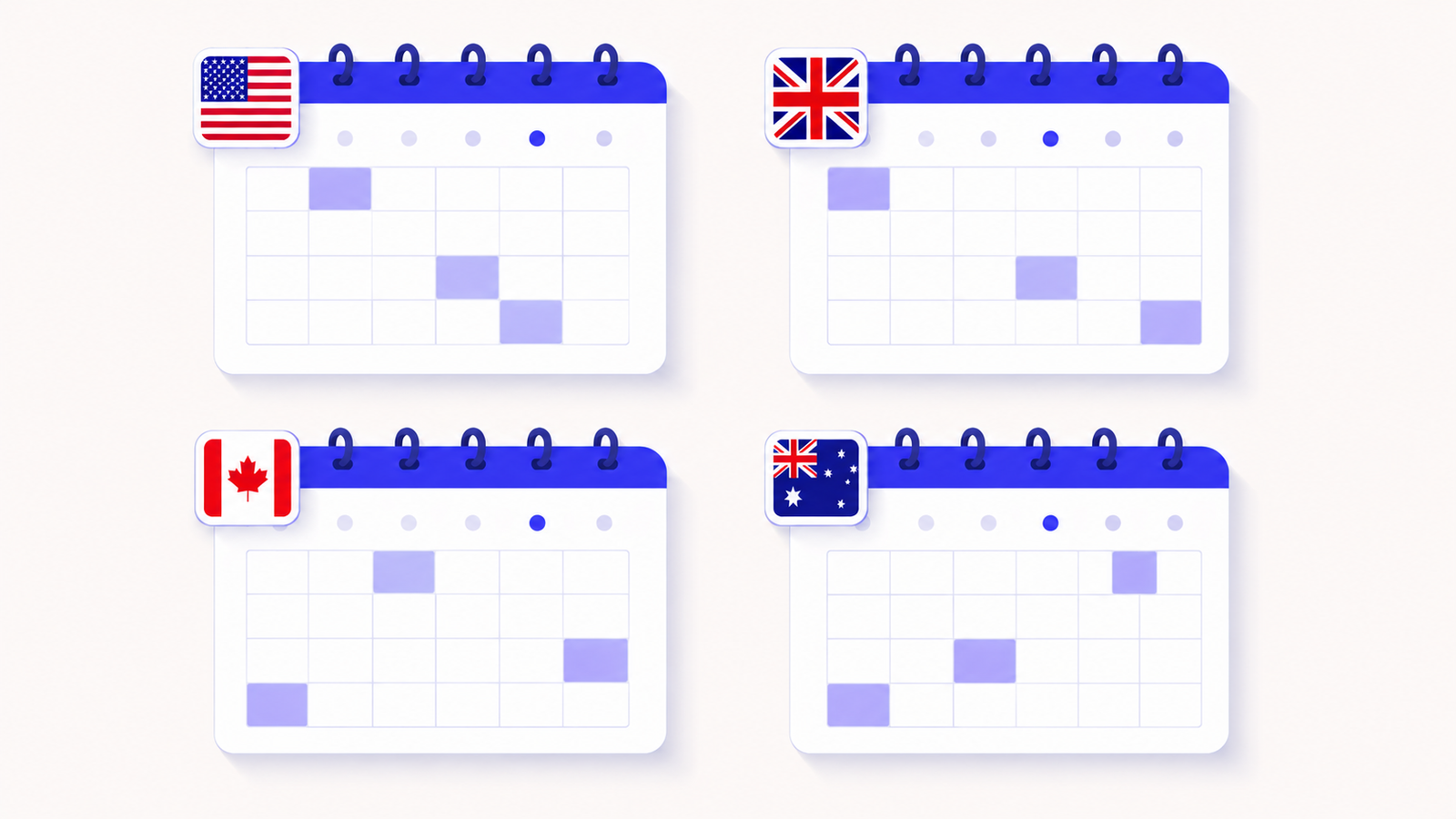
Why the count changes by country and region
Three things move the number.
Where the holidays fall. A public holiday on a Saturday or Sunday only costs you a working day if your country grants a substitute weekday. The US generally does for federal holidays. Australia's rules vary by state and by holiday.
Region inside a country. Canada and Australia set most holidays at the province or state level, not nationally. The UK splits four ways: England and Wales share 8 bank holidays, Scotland has 9, Northern Ireland has 10.
Your own calendar. Public holiday lists are the legal baseline. Your real working year also depends on paid leave, company closures and whether you run a 5-day or 6-day week. For planning that starts somewhere other than January, see our fiscal calendar guide.
What this means for payroll and project planning
For weekly payroll, watch for an extra pay run. Because 2026 is a 53-week year, weekly and biweekly cycles can land an extra payday depending on your pay dates. A weekly cycle can hit 53 pays instead of 52, and a biweekly one 27 instead of 26. Check your first pay date of the year against the calendar.
For salaried staff, the working hours barely move. 261 weekdays at 8 hours is 2,088 gross hours. Remove the 11 US federal holidays and a full-time US employee has about 2,000 working hours in 2026.
For project timelines, count in working days, not calendar days. A 30 working day task starting Monday 1 June 2026 doesn't land 30 calendar days later. It finishes in mid-July once weekends come out.
In Excel or Google Sheets, one formula does the counting:
CODE0
Point holidays_range at a list of your public holiday dates and it returns the working days, weekends already excluded.
FAQ
How many work weeks are in a year?
About 52. A year has 52 full weeks plus 1 or 2 days, and a standard work week is 5 days. In 2026 there are 261 weekdays, which is 52.2 work weeks.
How many working days are in 2026?
261 weekdays before holidays. After public holidays, it's 250 in the US, 253 in England and Wales, 251 for federally regulated workers in Canada, and about 255 nationally in Australia.
Why does 2026 have 53 weeks?
Under ISO 8601, a common year has 53 weeks when it starts on a Thursday. 2026 starts on Thursday 1 January, so week 53 runs to Sunday 3 January 2027.
How many work weeks are in a year for payroll?
Most employers plan around 52, but a weekly cycle can produce 53 paydays in a 53-week year like 2026, and a biweekly cycle can produce 27. It depends on your first pay date.
Is the number of working days the same in every country?
No. Weekends match, but public holidays differ. The US has 11 federal holidays in 2026, England and Wales have 8 bank holidays, and Canada and Australia set most holidays regionally.
Quick reference for 2026:
- 261 weekdays, 104 weekend days, 365 total days
- 52.2 work weeks; 53 ISO weeks because the year starts on a Thursday
- Working days: 250 US, 253 England & Wales, 251 Canada (federal), ~255 Australia (national)
- Convert any date to its week number with the week calculator
- Check a single date's weekday with the weekday calculator
- See the full year grid on the 2026 week numbers page
Sources and further reading: